

Proto-Life in a Time Field: How Dynamic Time-Density Learns to Grow Cells
What happens when you let “time” itself thicken, remember, and push back on matter?

We’re used to thinking of physics as “stuff moving in time”.
In this project, we flipped that around.
What if the primary thing isn’t stuff, but time itself?
What if time can thicken, store memory locally, and then push back on whatever is happening?
From that simple idea, simulated on a grid, something surprising fell out:
stable, cell-like bodies
tubular “tissues” and filaments
fossil-like structures
and a class of “breathing” entities that maintain their identity across environmental change
All of this emerges from a single extra ingredient added to a standard reaction–diffusion system: a time-density field that learns where interesting dynamics are happening and remembers them.
In this post we can skip most of the code and details and focus on:
What the model actually is (in plain language)
How we recognise proto-life behaviour in it
Why this matters for how we think about matter, life, and “the medium” everything lives in
For those who want to dig into the technical side, the full repository is here:
https://github.com/aether-machine/dynamic-tau-reaction-diffusion
What Is a Time-Density Field?

Instead of assuming time just “ticks” uniformly everywhere, we introduce a field τ(x, y, t).
Intuitively:
When τ is high in some region, time is “thick” there:
processes slow down, and history accumulates.When τ is low, things are loose and fast:
changes spread quickly, and the past doesn’t hold on.
Crucially, τ is not just a parameter. It is a dynamical field that:
responds to what is happening (chemical activity, gradients, etc.), and
feeds back by changing how easily things diffuse and organise.
The base chemical system is a classic two-species reaction–diffusion model known as the Gray–Scott system: two fields A(x, y, t) and B(x, y, t) that diffuse, react, and form spots, stripes, and other patterns.
On its own, Gray–Scott is a beautiful pattern generator.
With a dynamic τ attached, it becomes something else entirely.
How τ Talks To Chemistry
There are two key couplings.
τ changes how easily things diffuse.
Instead of constant diffusion, the effective diffusion coefficients of A and B depend on τ:
So:
Where τ is high, diffusion slows down (structures can solidify).
Where τ is low, diffusion speeds up (things dissolve or smear out).
τ itself evolves based on activity and resources.
The general evolution equation for τ in the final model (v5) looks like this:
Very roughly:
S(x, y, t) measures local activity:
a combination of reaction strength (A B²) and sharp boundaries (gradients of B).N(x, y, t) is a resource field, like a nutrient or fuel density.
α tells τ how strongly to respond to activity.
β relaxes τ back to a baseline τ₀ when nothing is happening.
γ couples the resource field N into τ.
κ_τ smooths τ over space (τ diffusion).
η_τ is noise in the time field.
So τ is like a memory density that thickens where activity is sustained, relaxes where nothing happens, and is biased by how much resource is available.
This lets the medium “remember” where something interesting has been happening.
Add a Resource Layer, Without Cheating
At first we were cautious about adding a “nutrient” field. It felt like a cheat: aren’t we trying to show life-like behaviour emerging from physics, not hard-code “food”?
But in this model N is not magic. It is just another scalar field that:
diffuses with its own coefficient,
is consumed where B is active,
and is gently replenished from the background.
The N field follows a simple equation of the form:
So N is more like “local capacity to support activity” than a biological nutrient.
It becomes the first internal abstraction layer the medium invents for itself:
Not all regions are equally ready to support structure.
Patterns that can position themselves in N-rich zones and maintain τ there, live longer.
What Counts As “Proto-Life” Here?
To avoid just projecting our wishes onto pretty patterns, we tried to quantify things.
For each simulation (each parameter configuration), we track:
Coherence: how strong and structured the combined field A + iB is.
Entropy: how disordered the B field is.
An energy-like quantity: how much “stuff” is there in A and B.
Autocatalysis: how strong the A B² reaction is.
τ-structure: how varied and textured the time-density field is in space.
Then we add morphological metrics on the snapshots of B, to get at organism-like behaviour:
maintenance_iou
Intersection-over-Union between the mid-time and final B masks.
Question: does the entity keep roughly the same body outline over time?internal_reorg_index
One minus the correlation of B values inside the body mask between mid and final times.
Question: how much does the interior reorganise while the boundary persists?com_shift_B
The shift in the centre of mass of B inside the body.
Question: does the mass drift or split?coherence_osc_index
The variance of coherence after removing a linear trend.
Question: does the system “breathe” around a stable coherence level?
These are plain, mechanical numbers. But when you look at them across parameter space, something emerges.
Three Regimes On The Q-Ridge
Sweeping the parameters, we find a narrow band (“Q-ridge”) where:
Coherence is high,
Entropy is relatively low,
τ has non-trivial structure,
and the morphological metrics show interesting behaviours.
Within that ridge, the system reliably falls into three regimes:
Breathing cells
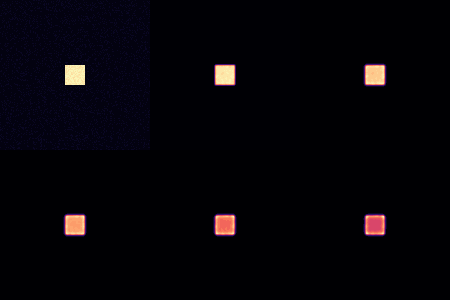
These runs have:
high maintenance_iou (the outline persists),
non-trivial internal_reorg_index (the inside keeps changing),
a clear coherence_osc_index (they “breathe” in coherence).
They behave like homeostatic proto-organisms:
same body, internally adapting, dynamically alive.
Crystallising cells
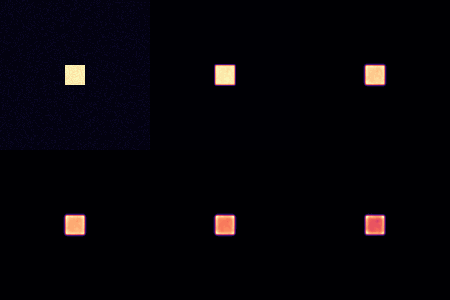
Here:
the outline is very stable,
the interior barely changes,
coherence just climbs to a plateau and sits there.
These are like τ-fossils: beautiful, highly ordered structures that don’t do much once they’ve formed. Memory without plasticity.
Melting foam
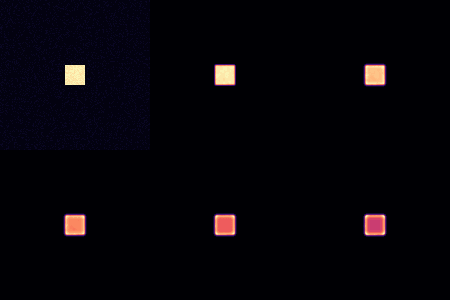
In these runs:
outlines are fragile,
internal_reorg_index is large,
coherence decays or becomes noisy.
These are overdriven states near dissolution or phase change. They’re not stable organisms, but they show what happens when the time-density medium is pushed too hard.
All three regimes use the same equations. Only the parameter settings differ.
This already looks a lot like a phase diagram of life-like behaviour.
What Happens When You Change The Environment?
Patterns alone aren’t enough to claim “proto-life”.
To move closer to something organism-like, we asked:
What happens if we gently change the environment around a candidate and run it again?
In practice, this means:
pick a “breathing cell” run, a crystallising run, and a melting run;
tweak the feed and kill parameters slightly up or down;
restart from the same initial condition each time;
compare the final state to the baseline final state.
For each environment variant we measure:
iou_vs_baseline: does the shape stay similar?
corr_vs_baseline: does the internal structure stay similar?
What we see:
Breathing cells:
keep their outline across a band of environments,
but reorganise their interior in response to stress.
This is exactly what you’d expect from something homeostatic: maintaining identity while adapting inside.
Crystallising cells:
keep both outline and interior rigidly the same.
They are robust, but not adaptive. They are more like crystals than organisms.
Melting regimes:
often keep a blurred version of the outline,
but completely rearrange or lose their interior,
or dissolve altogether.
They sit at the edge of failure.
This is the point where it becomes hard not to talk about proto-life.
We have:
a medium that remembers (τ),
a resource field (N),
a pattern field (B),
and closed local dynamics.
From that, we get entities that:
form,
maintain themselves,
adapt internally,
survive gentle changes in their environment,
or fossilise,
or melt down.
No explicit “life rule” was ever coded in.
Why This Matters
There are two levels to this.
On the local level, it is a proof of concept:
You can start from a single new physical ingredient (time-density),
couple it to a standard reaction–diffusion system,
and recover a small zoo of proto-organisms.
On the conceptual level, it suggests a different way of thinking about matter and life:
Matter is not the starting point;
it’s what persistent patterns in a time-density field look like to us.Life is not a biochemical exception;
it’s what happens when the time field learns to reinforce its own structures.
The “nutrient” field N is not a cheat. It is the first abstraction layer the medium builds:
a local measure of its ability to keep transforming.
It doesn’t add new magic to the model; it just makes explicit what any real medium already has: regions that are more or less able to support structure over time.
None of this replaces quantum field theory or the Standard Model.
But it does offer a concrete, testable sandbox where we can investigate:
how memory-bearing media generate organised structure,
how stability, plasticity, and failure coexist in the same equations,
and how “organisms” might be understood as attractors of a time-density field.
For now, this work lives as code, plots, and metrics in the repository:
https://github.com/aether-machine/dynamic-tau-reaction-diffusion
Our hope is that it can also live as a story:
that life is not an anomaly,
but a natural phase of any medium where time itself can thicken, remember, and push back.