


There is something very strange about a mathematical fluid developing an infinite velocity.
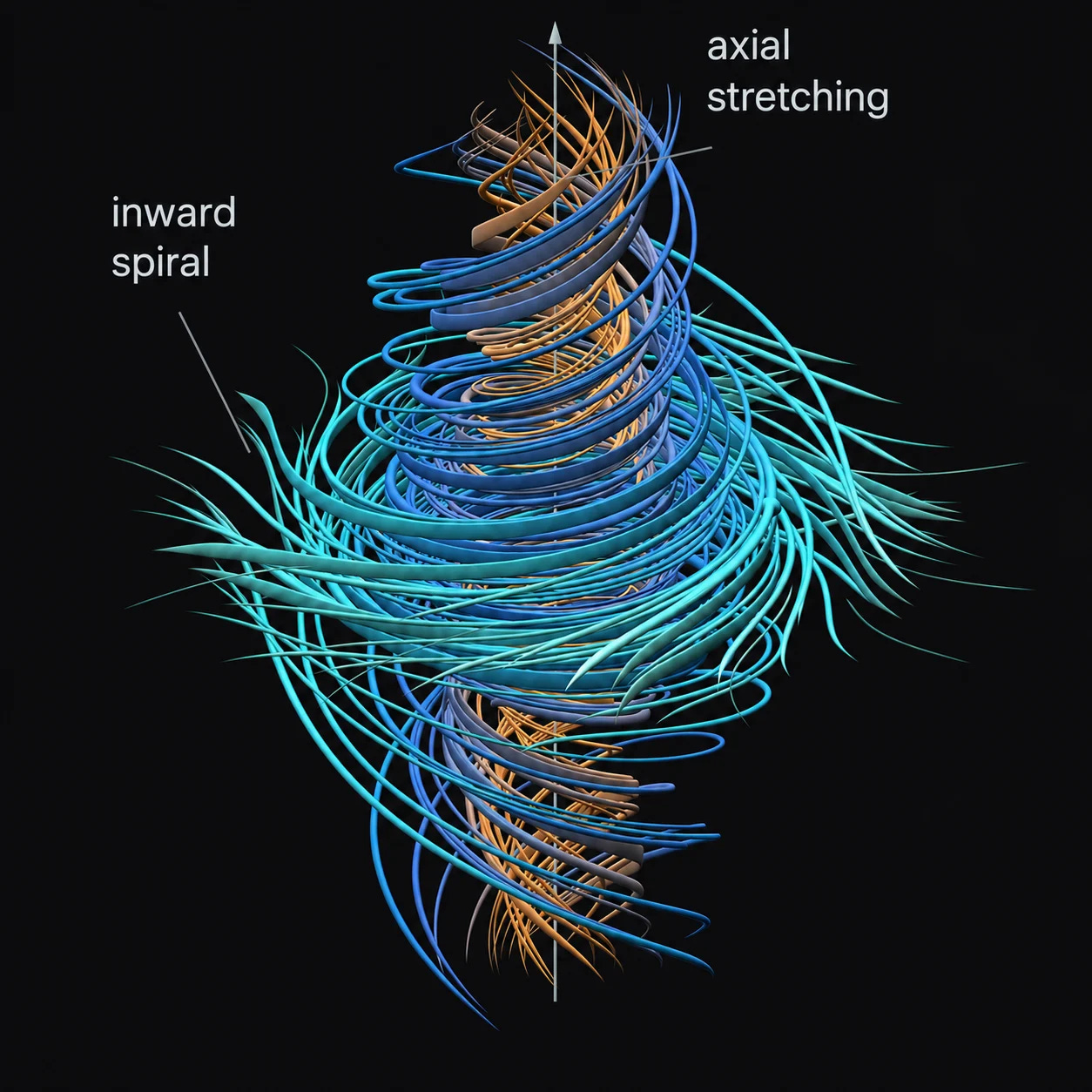
Not merely because infinity is strange.
But because the thing being described is water.
Water does not appear to contain a mechanism by which a finite amount of fluid suddenly acquires infinite speed. We can push it, heat it, compress it, whirl it, break it into droplets and drive it into turbulence. But at some point, ordinary physical intuition says that the description must encounter a limit.
This creates an uncomfortable possibility.
Maybe the infinity isn’t in the water.
Maybe it is in the description.
That thought led me down a rabbit hole involving the Navier–Stokes equations, coarse-graining, hidden variables, dynamical closure and, eventually, something I hadn’t originally been looking for:
memory.
Not memory in the psychological sense.
Memory as a mathematical signature of information that has disappeared from the variables we chose to keep.
And that raises a much bigger question:
What if some physical descriptions fail not because the world has become pathological, but because the description has forgotten something that the system itself has not?
I don’t know whether that is what happens in the Navier–Stokes problem.
I don’t think anyone should claim that it is.
But I think there is enough here to make the question worth asking.
The universe we calculate is not the universe we measure
The Navier–Stokes equations are among the great successes of mathematical physics.
They allow us to describe fluids without tracking every molecule.
Instead of following an astronomical number of individual particles, we introduce fields.
At every point in space and time, we assign quantities such as velocity, pressure, density and temperature.
This is an extraordinary compression of information.
Imagine trying to simulate a glass of water by calculating the trajectory of every molecule.
We don’t do that.
We throw almost all of the microscopic information away.
And remarkably, we can still predict the behaviour of the water.
This is not a flaw.
It is one of the reasons physics works.
The macroscopic description is useful precisely because we don’t need to know everything.
But there is a subtle distinction here that is easy to lose sight of.
The field isn’t the water.
Velocity is not a tiny substance sitting inside the fluid.
Pressure is not a microscopic object.
Temperature is not something we would discover if we zoomed into a molecule with a sufficiently powerful microscope.
These are collective variables.
They are descriptions of organised behaviour at a particular scale.
We could represent the hierarchy schematically as:
At every step, information is discarded.
Usually that is exactly what we want.
But perhaps there are circumstances where the discarded information becomes important again.
Physics succeeds by forgetting
This may be one of the strangest facts about effective theories.
They work by forgetting.
A microscopic system may have an enormous number of degrees of freedom.
We retain a handful.
The microscopic state might be represented schematically by X.
A coarse-graining operation C maps that enormous state into a much smaller representation H:
The remarkable thing is that H is often enough.
For many purposes, we can predict the future using only H.
That means the reduced description is approximately dynamically closed.
We can write:
The present coarse-grained state contains enough information to determine the evolution, at least to the accuracy we require.
But what happens when it doesn’t?
Suppose two different microscopic states have the same coarse representation:
If the two microscopic systems subsequently produce different coarse dynamics,
then H does not contain everything required to determine its own future.
The reduced description is not dynamically closed.
This is a much more precise statement than saying that “information was lost.”
Information is always lost.
The important question is whether the information that was lost was dynamically relevant.
I wanted to see whether this could actually happen
At this point, it would have been easy to turn the idea into philosophy.
I didn’t want to.
So I built a small computational laboratory.
The goal wasn’t to simulate the Navier–Stokes equations.
That would have been premature.
Instead, I wanted to construct a controlled system in which I knew the underlying dynamics were regular, deliberately discard information, and then ask what happens to the resulting effective description.
The basic experiment was simple.
Start with a microscopic system.
Construct a coarse-grained description.
Then find different microscopic states that produce the same coarse state.
If their future coarse dynamics diverge, the coarse variables aren’t sufficient.
That gives us a clean experimental definition of non-closure.
And something interesting happened.
They did.
Same present. Different future.
One of the simplest tests involved an underlying dynamical system whose microscopic state was known.
I constructed ensembles with the same retained variables but different higher-order structure.
At the coarse level, the two states were essentially indistinguishable.
Their initial retained mean and variance matched.
But the microscopic configurations differed.
The important observation was not that the hidden states were different.
Of course they were.
The important observation was that the difference could later become visible in the retained variables.
In other words:
Two systems can look identical at the level we have chosen to observe and nevertheless have different futures.
That is a very simple result.
But it has an important consequence.
There may be no exact autonomous equation of the form
for those coarse variables alone.
The problem isn’t necessarily that the underlying physics is complicated.
The problem is that the state vector (H) is incomplete.
The hierarchy gives the clue
The toy system made this especially clear because its moment hierarchy can be written explicitly.
For a microscopic variable obeying
the moments
satisfy
The equation for one moment therefore depends on higher moments.
For example,
If we retain only (m_1), we have thrown away information that directly affects its derivative.
If we retain (m_1) and (m_2), the problem has not disappeared.
The hierarchy continues.
There is always another level.
This is a familiar problem in statistical physics and kinetic theory.
Moment equations generate more moments.
Closure requires a rule for representing what has been omitted.
And that rule is where things become interesting.
The dangerous thing about closure
A reduced equation can be perfectly reasonable over the region where it was constructed and still behave badly outside it.
I tested this explicitly.
The underlying microscopic system contained a stabilising nonlinear term:
The (-x^5) term becomes important at large amplitude and prevents the underlying dynamics from running away.
I then trained deliberately simplified effective closures using only data from a restricted region.
Some of the low-order closures reproduced the training data reasonably well.
But when pushed outside the region where they had been trained, they could become pathological.
One of them produced enormous runaway behaviour even though the underlying system remained bounded.
This was useful precisely because it wasn’t a success.
It demonstrated something important:
A singular or runaway effective equation does not automatically imply a singular underlying system.
A pathological reduced model can be created simply by omitting dynamically important structure.
That doesn’t prove that the Navier–Stokes singularity is of this type.
But it establishes the mechanism as a real mathematical possibility.
The question became more interesting
At this point I had a mechanism.
Coarse-graining can destroy dynamical closure.
An effective equation can then behave very differently from the underlying system.
But what should replace the missing information?
The obvious answer is:
add more variables.
So I did.
I added higher moments.
And they helped.
But not very much.
Then I tried something different.
Instead of adding another instantaneous variable, I gave the effective model access to its own recent history.
Instead of
I allowed
Something unexpected happened.
History helped.
Perhaps the past contains information the present does not
This is where the word “memory” entered the project.
The important point is not that I inserted a memory term and obtained a nicer answer.
I didn’t want that kind of result.
I wanted to know whether temporal history contained predictive information that wasn’t present in the instantaneous coarse state.
So I compared models using instantaneous variables with models using finite histories.
The results showed a systematic reduction in prediction error as history was added.
For one set of experiments, the conditional uncertainty in the coarse derivative behaved approximately as follows.
The quantity being measured was essentially:
for the instantaneous representation, and
when history was included.
The fractional reduction was defined as:
At history length 16, the estimated unexplained variance had fallen by roughly 59%.
That doesn’t mean the system had acquired physical memory.
It means something more precise:
The recent history of the coarse variables contained information useful for predicting their future evolution that was not contained in the instantaneous coarse state alone.
That distinction matters.
But perhaps higher moments were simply being ignored
There was an obvious objection.
Maybe history only appeared useful because I had chosen the wrong instantaneous variables.
Perhaps I could recover the same predictive information simply by adding enough higher moments.
So I tested that too.
The underlying hierarchy gives us a natural comparison.
Instead of keeping (m_1,m_2), I could keep (m_1,\ldots,m_n).
Then I could compare that with an equal-complexity history representation.
The results were surprisingly consistent.
Adding moments through (m_5) produced only small improvements.
Adding more moments in the matched-complexity experiments quickly plateaued.
History, by contrast, continued to improve prediction.
The strongest controlled experiment compared representations with the same number of fitted parameters across eight independent train/test splits.
At the 12-parameter budget, for example, the history representation reduced RMS error by roughly 2.6%.
At the 36-parameter budget, the reduction was roughly 11.8%.
And the history representation had lower RMS error in every one of the eight independent splits.
That is much more interesting than simply saying “more data improves prediction.”
The representations had been given the same regression capacity.
So is memory the missing physics?
No.
At least, not yet.
This is where the experiment has to discipline the imagination.
The fact that history improves prediction does not establish that the underlying system contains fundamental memory.
History can be a proxy for many things.
It might encode unresolved variables.
It might encode correlations.
It might approximate higher-dimensional hidden state.
It might represent non-Markovian effects.
It might simply be a useful coordinate system for information that we have projected away.
There is an important difference between:
“Memory is physically fundamental.”
and:
“Memory is an effective representation of information missing from the instantaneous state.”
The experiments establish evidence for the second kind of statement.
They do not establish the first.
And that distinction is precisely what makes the result interesting.
What if memory is what forgotten information looks like?
Suppose I observe a complicated physical system but retain only a few variables.
The underlying system has not forgotten anything.
I have.
I have chosen to represent it using a compressed state.
If the compressed state is dynamically incomplete, the influence of the omitted variables has to appear somehow.
Perhaps it appears as extra variables.
Perhaps as noise.
Perhaps as nonlocality.
Perhaps as correlations.
Or perhaps as dependence on the past.
From the perspective of the reduced theory, the hidden degrees of freedom can leave behind a kind of historical trace.
That suggests a provocative interpretation:
Memory may be what unresolved structure looks like from inside a reduced description.
I don’t mean this as a fundamental law.
I mean it as a conceptual possibility.
And it changes the way I think about effective theories.
Perhaps the past is not necessarily an additional ingredient that nature carries around.
Perhaps it is sometimes the footprint left by information that our description has compressed away.
This brings me back to Navier–Stokes
Now return to the original problem.
The three-dimensional incompressible Navier–Stokes equations describe a continuum.
They don’t know about individual molecules.
They don’t know the microscopic velocity distribution.
They don’t know the detailed correlations between molecules.
They represent the fluid through a comparatively small collection of macroscopic fields.
Under ordinary conditions, this works extraordinarily well.
But imagine a mathematical solution developing structure on smaller and smaller length scales.
At some point, the assumption that the fluid can be treated as a smooth continuum must at least become something worth examining carefully.
One useful measure of the separation between kinetic and continuum scales is the Knudsen number:
where (\lambda) is a characteristic molecular mean free path and (L) is a characteristic length scale of the flow.
Continuum behaviour generally corresponds to
But if the relevant structure becomes sufficiently small,
then the microscopic information that was previously irrelevant may no longer be safely ignored.
That does not automatically regularise anything.
It does not prove that a singularity cannot occur.
But it suggests a question.
What happens to the effective description when the scale separation on which it depends begins to disappear?
Perhaps a singularity is a boundary marker
There is a difference between saying:
“Navier–Stokes is wrong.”
and saying:
“Navier–Stokes may have been extrapolated beyond the regime in which its retained variables form a dynamically closed description.”
The second possibility is much more subtle.
An effective theory can be extraordinarily accurate without being universally complete.
Its failure does not necessarily mean that every equation it contains was wrong.
It may mean that the variables were no longer sufficient.
This gives us another way to think about a singularity.
Perhaps the divergence is not a physical object.
Perhaps it is a warning.
A mathematical signal that the variables being used are trying to describe behaviour that requires information they no longer contain.
In that picture, the singularity is less like a physical explosion and more like a boundary marker.
It says:
This description has reached somewhere it cannot represent by itself.
What would the missing correction look like?
This is where the speculation becomes genuinely interesting.
If the instantaneous field variables cease to be dynamically sufficient, then the effective equations may need additional structure.
It could be higher moments.
It could be additional fields.
It could be nonlocality.
It could be stochasticity.
It could be unresolved correlations.
It could be some combination of these.
Or it could involve memory.
Instead of a purely instantaneous equation,
we might need something more like
The important point is not the exact form.
The important point is that the effective description would no longer be purely Markovian.
The future would depend not only on the present coarse state, but on information encoded in its history.
That is precisely the kind of structure that appeared in my toy experiments.
But there is an enormous gap between those experiments and Navier–Stokes.
And I don’t want to hide that gap.
The experiment does not solve Navier–Stokes
Nothing I have described demonstrates that memory regularises a Navier–Stokes singularity.
It doesn’t.
The computational systems I studied are deliberately simplified dynamical models.
They were chosen because they allow mechanisms to be isolated and tested.
The purpose was not to reproduce three-dimensional turbulence.
It was to ask a prior question:
Can coarse-graining produce a situation in which the effective variables are no longer dynamically sufficient, and can temporal history recover some of the missing predictive information?
The answer in these experiments was yes.
Whether the same mechanism exists in real fluid dynamics is a separate question.
Whether it matters at the scales associated with a Navier–Stokes singularity is another.
Whether it could produce a mathematically sufficient correction is another again.
Those questions require derivations from physical theory, not just suggestive numerical experiments.
That distinction is important enough to repeat.
A useful memory term cannot simply be invented because it makes an equation behave better.
If such a correction exists physically, it should emerge from an underlying theory and make predictions that can be independently tested.
But what if the idea goes deeper?
There is a more speculative thought that I keep coming back to.
If memory can appear as an effective representation of unresolved microscopic structure in an ordinary physical medium, perhaps the same conceptual mechanism could exist at deeper levels of description.
Suppose spacetime itself were not merely a passive stage on which physical events occur, but possessed some kind of history-dependent structure.
Then an effective physical law might, in principle, contain corrections that depend not only on the local state but on some aspect of the history of the underlying geometry or field configuration.
This is highly speculative.
The experiments above do not provide evidence for it.
But the question is structurally similar.
At one level:
and the coarse description may acquire effective memory.
At a deeper level, one could ask whether:
might produce something analogous.
If so, what looks like an unexplained correction at the effective level could conceivably be the residue of a deeper history.
I don’t know whether that is true.
But I think there is a useful scientific principle here:
Don’t introduce the correction first. Ask what underlying structure would derive it.
If an independent theory of spacetime memory ever produced a correction term that also emerged naturally in effective descriptions of physical media, that convergence would be worth taking seriously.
Until then, it remains a hypothesis.
The Lego universe
There is a philosophical picture lurking underneath all of this.
We often imagine the universe as a Lego set.
Everything is made from smaller things.
Find the smallest pieces.
Understand how they interact.
Then everything else should, in principle, follow.
There is an enormous amount of truth in this way of thinking.
Modern physics has uncovered layers of structure far beneath the everyday world.
But perhaps the Lego metaphor is incomplete.
Consider a human body.
If you take it apart, you find organs.
Take the organs apart and you find tissues.
Take the tissues apart and you find cells.
Take the cells apart and you find molecules.
Take the molecules apart and you find atoms and subatomic structure.
But understanding the smaller pieces doesn’t automatically give you the useful description of the larger system.
A heart is not simply “many molecules.”
A heartbeat depends on organisation.
A nervous system depends on relationships.
A cell depends on networks of interactions.
The higher-level description is not necessarily less real because it is not fundamental.
It is useful because it captures structure that is organised at that scale.
Perhaps physics is similar.
Perhaps the universe is not simply a hierarchy of smaller objects.
Perhaps it is a hierarchy of descriptions, relationships and transformations.
Maybe the fundamental question isn’t “what is it made of?”
We often ask:
What is this thing made of?
But perhaps another question is equally fundamental:
What information about the lower-level system survives when we construct the higher-level description?
That changes the philosophical picture.
A coarse-grained system doesn’t necessarily contain a miniature version of the microscopic world.
Instead, it contains certain collective consequences of that world.
Some information disappears.
Some survives.
Some becomes encoded indirectly.
Some may reappear as correlations.
And perhaps some survives as memory.
This suggests a different hierarchy:
The arrows need not mean that one level simply “creates” the next.
They can represent transformations between descriptions.
And perhaps the transformations themselves are part of the physics.
What if the boundary matters as much as the levels?
We tend to think of physical theories as occupying domains.
Quantum mechanics describes one regime.
Statistical mechanics another.
Fluid mechanics another.
Classical mechanics another.
We then imagine moving between them by changing the scale.
But perhaps the transition itself deserves more attention.
The interesting physics may not be only:
What happens at scale A?
or:
What happens at scale B?
It may be:
What happens when the description at A becomes insufficient and the description at B becomes necessary?
That is what I mean by a scale boundary.
Not a mysterious wall.
Not automatically “new physics.”
A boundary at which the variables that were previously sufficient cease to provide a dynamically closed description.
That could happen for many reasons.
A new degree of freedom may become relevant.
A previously negligible correlation may accumulate.
A nonlocal effect may become important.
A memory term may emerge.
Or an entirely different effective description may be required.
The boundary is where we should look.
Perhaps the universe doesn’t forget. We do.
There is a strange inversion here.
When we coarse-grain a physical system, we say that information has been lost.
But perhaps that is only true from the perspective of the reduced observer.
The microscopic system hasn’t necessarily lost anything.
The information is still encoded in its full state.
We are the ones who threw it away.
From that perspective, memory becomes less mysterious.
Imagine observing a complicated system through a tiny window.
At one instant, two microscopic configurations can project onto the same visible state.
But as time passes, their hidden differences influence what happens next.
If you only look at the present snapshot, the future seems unpredictable.
If you look at the recent history, some of the hidden structure becomes inferable.
The past is giving you information about the part of the present that you cannot directly see.
That is exactly what happened in the experiments.
The history wasn’t magic.
It was information.
And that changes the way I think about memory
We normally think of memory as something a system possesses.
A brain has memory.
A computer has memory.
A material can have hysteresis.
A biological system can retain history.
But perhaps there is another kind.
Effective memory.
A reduced description can behave as though it has memory because the variables it has discarded continue to influence its future.
The underlying system may remain completely Markovian.
The reduced system does not.
That distinction is familiar in many areas of physics.
But the philosophical interpretation is interesting.
Perhaps memory is sometimes not an additional physical substance.
Perhaps it is the mathematical consequence of looking at a system through an incomplete set of variables.
If so, the appearance of memory at a scale boundary might be telling us something about what lies beneath the description.
Where this leaves the singularity
I started with a simple question:
What if the singularity isn’t in the water?
I still don’t know the answer.
But I now think the question can be made much more precise.
Suppose a continuum theory describes a physical system by a set of coarse variables (H).
Suppose those variables are dynamically closed while the relevant scale separation is large.
Then imagine the system evolves towards a regime where the characteristic structures become sufficiently fine that previously discarded degrees of freedom become dynamically relevant.
The effective description might cease to satisfy:
A richer description might instead require additional state variables, hidden degrees of freedom, nonlocal terms or history dependence:
If we insist on describing the system using the old variables anyway, the resulting equation might develop pathological behaviour.
Perhaps a divergence.
Perhaps a singularity.
Perhaps an apparent instability.
Perhaps simply a failure of prediction.
That is a hypothesis.
But it is a hypothesis with a mechanism behind it.
The question I actually want to ask
I don’t think the most interesting question is:
Can memory fix Navier–Stokes?
That is too narrow, and it puts the conclusion before the investigation.
The more interesting question is:
When an effective physical description approaches the limit of its validity, what mathematical form does the information it has discarded take when it becomes dynamically relevant again?
Maybe it appears as higher moments.
Maybe as additional fields.
Maybe as correlations.
Maybe as nonlocality.
Maybe as stochasticity.
Maybe as memory.
And perhaps different physical systems choose different answers.
That would make scale boundaries more than transitions between resolutions.
They would become places where the structure of effective physics reveals itself.
There is still a long way to go
The computational experiments are deliberately modest.
They do not establish a new law of physics.
They do not demonstrate that spacetime has memory.
They do not regularise a Navier–Stokes singularity.
They do not establish that memory is fundamental.
What they do establish, within the tested models, is something smaller and more useful.
Coarse-graining can destroy dynamical closure.
A regular underlying system can produce pathological behaviour in an improperly closed effective description.
Temporal history can contain predictive information that is absent from the instantaneous coarse state.
And, under controlled matched-complexity comparisons, finite history can outperform additional instantaneous moments as a representation of that missing predictive information.
Those are the results.
The rest is the question they leave behind.
Maybe the infinity is a clue
Perhaps the most interesting possibility is not that Navier–Stokes is simply wrong.
Perhaps the equations are doing exactly what they are supposed to do.
They describe the system in terms of a particular set of variables.
They work extraordinarily well across an enormous range of physical conditions.
And then, somewhere at the edge of their domain, the mathematics begins asking them to represent something that those variables were never designed to contain.
The equation responds with an infinity.
Perhaps that infinity is physical.
Perhaps it is mathematical.
Perhaps it is telling us something about the underlying system.
Or perhaps it is telling us something about the limits of the representation.
We don’t know.
But there is another possibility.
Perhaps when a physical description forgets too much, the information it discarded doesn’t disappear.
Perhaps it returns as a correction.
Perhaps as correlation.
Perhaps as nonlocality.
Perhaps as another degree of freedom.
Perhaps as memory.
And if that is true, then the boundaries between physical descriptions may be more interesting than the descriptions themselves.
Maybe the universe isn’t a Lego set after all.
Maybe physical reality is a hierarchy of structures, and each level carries traces of the levels beneath it.
Maybe the past survives inside the present in ways that our equations only reveal when we have compressed the system too aggressively.
And maybe a singularity is sometimes what happens when an equation tries to describe a system after it has forgotten something it can no longer afford to forget.
Maybe the infinity isn’t in the water.
Maybe it is in an equation that has forgotten.
And perhaps the physics we need at the boundary is not simply an equation that is more accurate.
Perhaps it is an equation that remembers.