


1. Introduction — From Planets to Particles
Saturn’s rings and the atomic shell both show a mysterious kind of order: discrete layers that persist, oscillate, and resist decay.
At the largest and smallest scales, nature seems to prefer quantized structure.
In this study, we propose that such discreteness emerges naturally from nonlinear field dynamics, in which standing-wave attractors trap energy into stable configurations called oscillons.
These may be the fundamental mechanism behind the apparent quantization of matter — and the “memory” that structures the cosmos.

2. Background — From Rings to Fields
The Saturn Analogy
Saturn’s rings behave like the fossilized echoes of past orbital resonances — frozen waves of motion and memory.
When we zoom down in scale, atoms display a similar pattern: stable shells, discrete energy states, harmonics that define structure.
The hypothesis: both are governed by the same underlying principle — resonant self-organization in a nonlinear medium.
The Bridge
We can express both systems with a single generalized attractor equation:
and stability occurs at radii where both the function and its derivative vanish:
This defines standing-wave nodes — memory points in space-time.
3. Nonlinear Fields and Oscillons
In classical field theory, when a field’s self-interaction term becomes strong enough, something remarkable happens:
energy stops dispersing and begins to self-trap.
The result is an oscillon — a localized, breathing wave packet that can persist for thousands of cycles.
Mathematically, this arises from the nonlinear Klein–Gordon equation:
with potential:
These self-trapped oscillations correspond to stable quantized attractors — dynamic analogues of planets, electrons, or even living systems.
4. Oscillon Formation: A Simple Simulation
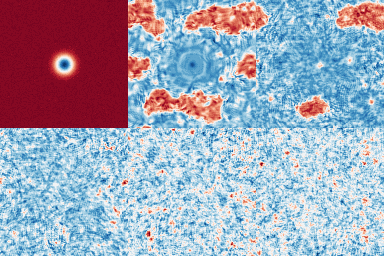
Below is a minimal Python prototype to visualize oscillon emergence. You’ll observe small fluctuations coalescing into persistent, breathing packets — the field-theoretic equivalents of planetary rings or atomic shells:
#!/usr/bin/env python3
“”“
kg_oscillon_mode_inference.py

2D classical scalar field (Higgs-like) simulator + modal extraction + sliding-window linear inference.

Saves results to ./outputs_kg/
“”“

import os, math, time
import numpy as np
import matplotlib.pyplot as plt
from scipy import fftpack, ndimage, linalg, signal
from sklearn.linear_model import Ridge
from tqdm import trange
import imageio

# -----------------------------
# PARAMETERS (tweakable)
# -----------------------------
outdir = “outputs_kg”
os.makedirs(outdir, exist_ok=True)

# lattice
Nx = 128            # x grid points
Ny = 128            # y grid points
dx = 1.0            # spatial step (arbitrary units)
dy = dx

# time integration
dt = 0.1            # time step (must satisfy CFL for stability)
nsteps = 2000       # total timesteps to simulate (increase for longer runs)
snap_every = 10     # save snapshot every N steps

# physical parameters (Higgs-like)
c = 1.0             # wave speed
mu = 0.8            # linear mass parameter (controls curvature near origin)
lam = 0.5           # quartic coupling

# initial condition: Gaussian bump
bump_amp = 2.0
bump_sigma = 6.0    # in grid units
bump_x = Nx//2
bump_y = Ny//2

# small random background noise
noise_amp = 0.02

# modes to track: low-k Fourier modes (choose radial shell indices)
kmax_modes = 10    # number of lowest k shells to track (you can increase)

# sliding-window inference
window_frames = 25  # number of frames in sliding window (for M inference)
step_frames = 5
ridge_alpha = 1e-2  # regularization

# -----------------------------
# Utility functions
# -----------------------------
def potential_deriv(phi):
    # V’(phi) = -mu^2 * phi + lambda * phi^3
    return - (mu**2) * phi + lam * (phi**3)

def local_energy_density(phi, phi_dot):
    # energy density: 0.5 * phi_dot^2 + 0.5*c^2*(grad phi)^2 + V(phi)
    gx, gy = np.gradient(phi, dx, axis=0), np.gradient(phi, dy, axis=1)
    grad2 = 0.5 * c**2 * (gx**2 + gy**2)
    kin = 0.5 * (phi_dot**2)
    pot = -0.5 * (mu**2) * (phi**2) + 0.25 * lam * (phi**4)
    return kin + grad2 + pot

# Fourier helpers to get radial k indices
kx = fftpack.fftfreq(Nx, d=dx) * 2 * np.pi
ky = fftpack.fftfreq(Ny, d=dy) * 2 * np.pi
KX, KY = np.meshgrid(kx, ky, indexing=’ij’)
KR = np.sqrt(KX**2 + KY**2)
KR_flat = KR.flatten()
sorted_idx = np.argsort(KR_flat)

# create mapping from radial bins to mode index
k_vals_unique = np.unique(np.round(KR_flat, 6))
# We’ll take lowest nonzero k shells
k_shell_indices = []
kr_sorted = np.sort(np.unique(np.round(KR,6).flatten()))
# pick k shells excluding k=0
kr_nonzero = kr_sorted[kr_sorted>0]
# select first kmax_modes distinct shells
selected_kr = kr_nonzero[:kmax_modes]
# map pixels to nearest selected shell
shell_masks = []
for kr in selected_kr:
    mask = np.isclose(KR, kr, atol=1e-6)
    shell_masks.append(mask)

# -----------------------------
# Initialize fields
# -----------------------------
# phi[x,y], phi_prev for leapfrog (phi at t - dt), and phi_dot estimate
phi = np.zeros((Nx,Ny), dtype=float)
phi_dot = np.zeros_like(phi)
phi_prev = np.zeros_like(phi)

# Gaussian bump
x = np.arange(Nx); y = np.arange(Ny)
X, Y = np.meshgrid(x, y, indexing=’ij’)
r2 = (X - bump_x)**2 + (Y - bump_y)**2
phi += bump_amp * np.exp(-0.5 * r2 / (bump_sigma**2))
# small noise
phi += noise_amp * (np.random.randn(Nx,Ny))

# initialize phi_prev by small backward Euler (approx)
phi_prev = phi - dt * phi_dot

# Preallocate storage
snapshots = []
energy_maps = []
mode_amplitudes = []  # will store complex-ish amplitudes per frame (we track real cosine projections)
times = []

print(”Starting simulation: Nx,Ny =”, Nx, Ny, “nsteps =”, nsteps)
start_time = time.time()

# -----------------------------
# Time integration loop (leapfrog / finite difference)
# -----------------------------
for tstep in trange(nsteps):
    # compute laplacian (finite difference)
    lap = (np.roll(phi, -1, axis=0) + np.roll(phi, 1, axis=0) +
           np.roll(phi, -1, axis=1) + np.roll(phi, 1, axis=1) - 4*phi) / (dx*dx)
    # leapfrog update (second-order)
    # phi_next = 2*phi - phi_prev + dt^2 * (c^2 * lap - V’(phi))
    phi_next = 2*phi - phi_prev + (dt**2) * (c**2 * lap - potential_deriv(phi))
    # update phi_dot approx
    phi_dot = (phi_next - phi_prev) / (2.0*dt)
    # shift
    phi_prev[:] = phi
    phi[:] = phi_next

    # Save snapshots and compute modes every snap_every steps
    if (tstep % snap_every) == 0:
        times.append(tstep * dt)
        snapshots.append(phi.copy())
        ed = local_energy_density(phi, phi_dot)
        energy_maps.append(ed.copy())
        # compute Fourier transform and project onto k-shells
        phi_k = fftpack.fft2(phi)
        # rearrange and compute amplitude per shell as RMS of real-space energy in that shell
        amps = []
        for mask in shell_masks:
            # sum of absolute phik in mask region as measure of amplitude
            val = np.mean(np.abs(phi_k[mask])**2)  # power per shell
            amps.append(np.sqrt(val))
        mode_amplitudes.append(np.array(amps))

end_time = time.time()
print(”Simulation done in %.1f s” % (end_time - start_time))

mode_amplitudes = np.array(mode_amplitudes)  # shape (frames, k_modes)
mode_amplitudes = mode_amplitudes.T          # now (k_modes, frames)
times = np.array(times)

# -----------------------------
# Save a few diagnostic images
# -----------------------------
plt.figure(figsize=(6,5))
plt.imshow(snapshots[0], cmap=’RdBu’, origin=’lower’)
plt.title(”Initial phi (t=0)”)
plt.colorbar()
plt.savefig(os.path.join(outdir,”phi_initial.png”), dpi=200)
plt.close()

plt.figure(figsize=(6,5))
plt.imshow(energy_maps[0], cmap=’magma’, origin=’lower’)
plt.title(”Initial energy density”)
plt.colorbar()
plt.savefig(os.path.join(outdir,”energy_initial.png”), dpi=200)
plt.close()

# animate a small number of frames into GIF for inspection
gif_frames = []
gif_path = os.path.join(outdir, “phi_evolution.gif”)
for i in range(0, min(200, len(snapshots))):
    arr = snapshots[i]
    # normalize for display
    img = (arr - arr.min()) / (arr.max() - arr.min() + 1e-12)
    img8 = (plt.cm.RdBu(img) * 255).astype(np.uint8)
    gif_frames.append(img8)
imageio.mimsave(gif_path, gif_frames, fps=12)
print(”Saved GIF:”, gif_path)

# -----------------------------
# Plot mode amplitude time series
# -----------------------------
plt.figure(figsize=(10,6))
for i in range(mode_amplitudes.shape[0]):
    plt.plot(times, mode_amplitudes[i], label=f”k{i}”)
plt.xlabel(”time”)
plt.ylabel(”mode amplitude (arbitrary)”)
plt.title(”Mode amplitudes vs time”)
plt.legend(ncol=4, fontsize=8)
plt.savefig(os.path.join(outdir,”mode_amplitudes.png”), dpi=200)
plt.close()

# -----------------------------
# Compute PSD of modes to look for persistent peaks
# -----------------------------
from scipy.signal import welch
plt.figure(figsize=(10,6))
for i in range(mode_amplitudes.shape[0]):
    f, Pxx = welch(mode_amplitudes[i], fs=1.0/(dt*snap_every), nperseg=128)
    plt.semilogy(f, Pxx, label=f”k{i}”)
plt.xlabel(”frequency (1/time)”)
plt.ylabel(”power”)
plt.title(”PSD of mode amplitude time series”)
plt.legend(ncol=4, fontsize=8)
plt.savefig(os.path.join(outdir,”modes_psd.png”), dpi=200)
plt.close()

# -----------------------------
# Sliding-window inference: dX = M X  (X is stacked mode amplitudes)
# -----------------------------
X = np.vstack([mode_amplitudes.real, np.zeros_like(mode_amplitudes)])  # simple real-only state (2N placeholder)
# We’ll use just real amplitudes as state (shape N x T). For generality we could include phases.
X = mode_amplitudes  # shape (N, T)
Tframes = X.shape[1]
# derivative
dX = np.zeros_like(X)
dX[:,1:-1] = (X[:,2:] - X[:,:-2]) / (2.0 * dt * snap_every)
dX[:,0] = (X[:,1]-X[:,0]) / (dt * snap_every)
dX[:,-1] = (X[:,-1]-X[:,-2]) / (dt * snap_every)

# sliding windows
M_list = []
windows = []
idx = 0
while idx + window_frames <= Tframes:
    t0 = idx
    t1 = idx + window_frames
    Xw = X[:, t0:t1]
    dXw = dX[:, t0:t1]
    # Solve ridge: M = dXw * Xw^T * (Xw*Xw^T + alpha I)^-1
    XXt = Xw.dot(Xw.T)
    alpha = ridge_alpha
    inv_term = linalg.inv(XXt + alpha * np.eye(XXt.shape[0]))
    Mhat = dXw.dot(Xw.T).dot(inv_term)
    M_list.append(Mhat)
    windows.append((t0,t1))
    idx += step_frames

M_arr = np.array(M_list)  # shape (nwindows, N, N)
print(”Inferred M array shape:”, M_arr.shape)

# Save M heatmaps
for i, M in enumerate(M_arr):
    plt.figure(figsize=(6,5))
    plt.imshow(np.abs(M), origin=’lower’, cmap=’inferno’, aspect=’auto’)
    plt.colorbar(label=’|M|’)
    plt.title(f”Coupling magnitude |M| window {i}”)
    plt.xlabel(”mode j”)
    plt.ylabel(”mode i”)
    plt.savefig(os.path.join(outdir, f”coupling_heat_{i:03d}.png”), dpi=200)
    plt.close()

# Save arrays for later
np.save(os.path.join(outdir, “mode_amplitudes.npy”), mode_amplitudes)
np.save(os.path.join(outdir, “M_arr.npy”), M_arr)
np.save(os.path.join(outdir, “times.npy”), times)

# Forward simulation validation for first window
if len(M_list) > 0:
    M0 = M_list[0]
    t0, t1 = windows[0]
    Xobs = X[:, t0:t1]
    Xsim = np.zeros_like(Xobs)
    Xsim[:,0] = Xobs[:,0]
    for tt in range(1, Xobs.shape[1]):
        Xsim[:,tt] = Xsim[:,tt-1] + (dt * snap_every) * (M0.dot(Xsim[:,tt-1]))
    # plot observed vs sim for first few modes
    for mi in range(min(6, X.shape[0])):
        plt.figure(figsize=(6,3))
        plt.plot(np.arange(Xobs.shape[1]), Xobs[mi,:], label=’obs’)
        plt.plot(np.arange(Xobs.shape[1]), Xsim[mi,:], ‘--’, label=’sim’)
        plt.title(f”Window0 mode {mi} obs vs sim”)
        plt.legend()
        plt.savefig(os.path.join(outdir, f”validate_mode{mi}_w0.png”), dpi=200)
        plt.close()

print(”All outputs saved to”, outdir)
print(”Finished.”)
5. Quantized Attractors — Discrete Stability Bands
Each oscillon represents a dynamically stable mode, a “slot” where energy can rest.
These states are not imposed but self-selected through nonlinear resonance.
In this sense, quantization emerges as a constraint on stability, not a pre-existing rule.
We can generalize this condition as:
where Ω0 is the system’s natural base frequency, m is an integer or rational fraction, and Δ is the locking tolerance.
This resonance-lock condition defines the allowed “energy levels” of the system —
the same principle behind Saturn’s ring gaps, atomic orbitals, and perhaps the entire quantum spectrum.
6. Interpretation — Matter as Memory
This framing reveals a universal architecture:
matter is a hierarchy of self-stabilized oscillons, from the quantum to the cosmic.
Each stable state is a record of coherence — a harmonic fossil of resonance that continues to write itself forward in time.
7. Implications
Unification: Quantum discreteness and macroscopic structure may arise from the same self-organizing principles.
Information: Energy flow naturally encodes information through resonance and persistence.
Gravity: May emerge from collective memory effects of many coupled oscillons.
Higgs Analogy: The Higgs boson might represent a stable quantized oscillon in the Higgs field — the field’s own self-locked attractor.
8. Toward Experimental Tests
- Numerical: Identify oscillon spectra in classical field simulations (Klein–Gordon, sine-Gordon).
- Laboratory: Observe energy localization and self-trapping in plasma or optical media.