


A state space synthesizer can be understood most easily by direct comparison with the conventional analog synthesizer. Many familiar functions still exist, but their meaning changes. The signal path is no longer best described as source, shaper, and amplifier. Instead, it is a dynamical system composed of states, forces, nonlinearities, and observations.
This section defines the practical terminology of the system by translating historical synthesizer terms into state space terms.
1. Oscillator -> Forcing Function or State Generator
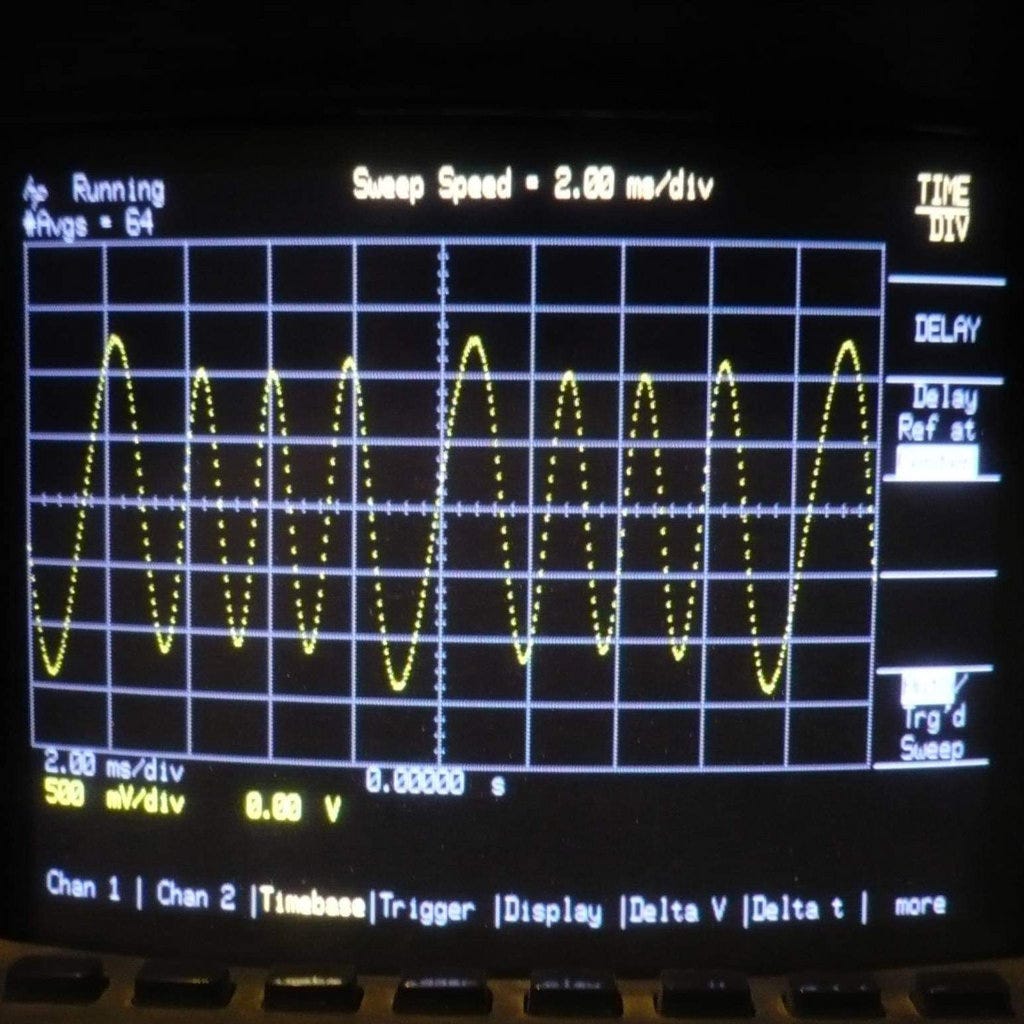
In a conventional synthesizer, the oscillator is the primary sound source. It produces a periodic waveform that is then shaped by the rest of the instrument.
In a state space synthesizer, the equivalent function may take two forms.
The first is a forcing function. This is an external drive applied to the state system. Its role is not simply to produce a tone, but to inject energy and structure into the dynamics. A sine wave, polynomial oscillator, or other periodic source may serve as a forcing term rather than as the final audible voice.
The second is a state generator. In some systems, oscillation arises internally from the system’s own equations. In that case, what would historically be called the oscillator is not a separate block at all, but an emergent behavior of the state core.
So in manual terms:
traditional oscillator = forcing generator or emergent state motion
pitch control = forcing frequency or system rate parameter
waveform selection = forcing law or state trajectory class
2. Filter -> Potential Field or Nonlinear Constraint
In a subtractive synthesizer, the filter shapes the harmonic content of a source after generation.
In a state space synthesizer, the corresponding role is often played by the potential field, restoring law, or nonlinear constraint. These elements do not remove harmonics from an existing signal. Instead, they determine how the system moves, where it is stable, and how it returns or escapes.
For example, in a driven double-well system, the −x+x^3 term is not a filter in the classical sense. It is the restoring structure that defines the wells and the barrier between them. It shapes motion rather than spectrum directly.
So in manual terms:
traditional filter = restoring law
cutoff = barrier height, well depth, or constraint threshold
resonance = state sensitivity near instability, or energy recirculation
filter mode = potential topology
3. VCA -> Observation Depth or Energy Gate
In a conventional synthesizer, the VCA controls output amplitude.
In a state space synthesizer, there are two related functions that may replace it.
The first is observation depth. Since the output is a measurement of one or more state variables, amplitude control may simply be control over how strongly a state is observed.
The second is an energy gate. Rather than scaling the final output, some systems are more naturally controlled by altering how much energy enters or remains in the system. In this case, amplitude-like behavior comes from changing forcing or damping rather than from multiplying the audio output directly.
So in manual terms:
traditional VCA = observation gain or energy gate
amplitude envelope = time-varying observation or time-varying forcing/damping
4. Envelope -> Parameter Trajectory
In a subtractive instrument, the envelope shapes amplitude, filter cutoff, or pitch over time.
In a state space synthesizer, the equivalent is a parameter trajectory. Instead of shaping a signal directly, it changes the conditions under which the system evolves. This may mean varying damping, drive amplitude, coupling strength, or barrier structure over time.
An envelope therefore acts less like a contour applied to sound and more like a controlled movement through behavioral space.
So in manual terms:
traditional envelope = parameter trajectory
ADSR = time-programmed regime control
attack/decay = entry and exit dynamics
modulation envelope = directed movement through state space
5. LFO -> Slow Forcing or Slow Parameter Field
The LFO survives almost unchanged, but its role becomes more general.
In a conventional synthesizer, the LFO modulates pitch, cutoff, or amplitude.
In a state space synthesizer, a slow oscillator may act either as a slow forcing term or as a slow parameter field. It can periodically perturb the system from outside, or it can slowly deform the system’s internal structure.
So in manual terms:
traditional LFO = slow forcing function or slow parameter modulation
vibrato = forcing-frequency perturbation
tremolo = observation-gain or energy perturbation
filter sweep = potential-field sweep
6. Resonance -> Recirculation Sensitivity
In the subtractive model, resonance refers to emphasis around a cutoff frequency.
In a state space synthesizer, the more general concept is recirculation sensitivity. This describes how strongly the system reinforces motion near a boundary, instability, or preferred trajectory. The behavior may sound resonant, but it is better understood as increased sensitivity of the evolving state to feedback and confinement.
So in manual terms:
traditional resonance = recirculation sensitivity
self-oscillation = autonomous limit cycle
resonance peak = state concentration near a dynamic boundary
7. Voice -> State Core
In a conventional synthesizer, a voice is a complete signal path capable of producing one note.
In a state space synthesizer, the closest equivalent is the state core: the system of coupled variables and equations that defines the instrument’s behavior. A single state core may not behave like a note generator in the traditional sense. It may drift, lock, hop, oscillate, or destabilize depending on how it is driven.
So in manual terms:
traditional voice = state core
polyphony = multiple state cores or coupled state networks
mono voice = single dynamical solver
8. Modulation -> Coupling
In subtractive synthesis, modulation often means one block varying a parameter of another.
In a state space synthesizer, the deeper concept is coupling. One state, forcing function, or parameter field influences another not just as decoration, but as part of the structure of the total system. Frequency modulation, cross-modulation, and feedback become specific cases of coupling between dynamical elements.
So in manual terms:
traditional modulation = coupling
FM = periodic forcing of rate or phase
cross-modulation = inter-system coupling
feedback modulation = self-coupling
9. Timbre -> Regime and Projection
In a conventional synthesizer, timbre is largely spectral shape.
In a state space synthesizer, timbre depends on two things: the regime the system is in, and the projection being observed.
The regime determines the type of motion: confined, periodic, bistable, irregular, chaotic. The projection determines which part of that motion is heard: one state variable, another state variable, or a mixture of several.
So in manual terms:
traditional timbre = regime plus observation
waveform = state projection
spectral character = observable consequence of the current trajectory
10. Performance Control -> Regime Navigation
The most important practical change is this: control is no longer primarily about shaping a fixed sound, but about moving the system between behaviors.
A performer is therefore navigating regimes:
stable confinement
barrier crossing
periodic orbit
locking
asymmetry
turbulence
collapse into another mode
So in manual terms:
traditional performance control = regime navigation
expressive sweep = trajectory steering
sweet spot = stable attractor region
instability = regime boundary
Summary Translation Table
A concise translation looks like this:
Oscillator -> forcing generator / emergent state motion
Filter -> restoring law / potential field / nonlinear constraint
VCA -> observation gain / energy gate
Envelope -> parameter trajectory
LFO -> slow forcing / slow parameter field
Resonance -> recirculation sensitivity
Voice -> state core
Modulation -> coupling
Timbre -> regime plus projection
Performance -> regime navigation
Operational Definition
A state space synthesizer is an instrument in which the conventional roles of source, shaper, and amplifier are replaced by state variables, forcing functions, nonlinear constraints, coupling terms, and observation paths.
Sound is produced by observing the motion of the system rather than by shaping a fixed waveform.
That is why the most useful language for these instruments is based less on waveform and filter metaphors, and more on trajectory, stability, transition, and motion.
You can follow the progress of the open source state space synthesizer project in the following link, we are working on universal PCB boards for DIY, but for now schematics can be found here.