
Analog synthesizers are commonly designed according to a conceptual paradigm that was formalised in the 1960s: oscillators, filters, amplifiers, envelopes, and modulation sources. This subtractive architecture has been historically successful and remains central to modern instrument design. From the standpoint of circuit theory, however, it represents only one region of a much larger space of possible analog sound-generating systems.
An analog computer can implement continuous-time dynamical systems directly by means of integrators, summers, multipliers, transconductance elements, and nonlinear transfer functions. When such systems are operated at audio rates, the result is not simply a conventional synthesizer voice with added distortion or modulation. Instead, the circuit itself functions as a real-time solver for a differential equation, and the resulting sound is the observed behavior of that system.
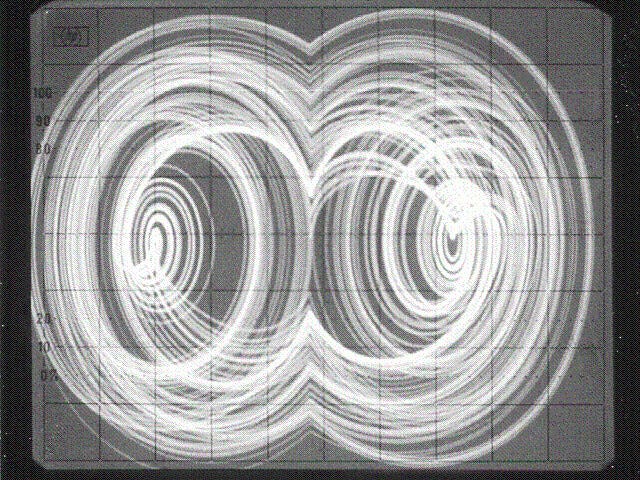
The circuit presented here is a prototyped implementation of a driven double-well nonlinear system related to the Duffing equation. In normalized form, the governing equation may be written as
where b is a damping term and E(t) is an external drive. The negative linear term and positive cubic term together produce the characteristic double-well structure. Unlike the harmonic oscillator, which has a single stable region centered on the origin, this system contains two preferred regions of motion separated by an unstable barrier.
This distinction is not only mathematical. It has immediate consequences for sound generation. Depending on damping, drive amplitude, and drive frequency, the circuit can remain confined to one well, cross periodically between wells, or enter irregular and chaotic regimes. In this sense, the output is not best understood as a stable waveform that is later shaped by filtering, but as a time-varying state trajectory being measured directly.
That difference suggests a broader way of thinking about analog synthesis. In a conventional subtractive instrument, sound generation typically begins with a relatively stable periodic source, which is then shaped spectrally and dynamically. In a nonlinear state-space circuit, sound arises from the evolving behavior of the system itself. Parameters such as forcing and damping do not merely color a tone; they alter the qualitative behavior of the underlying dynamics.
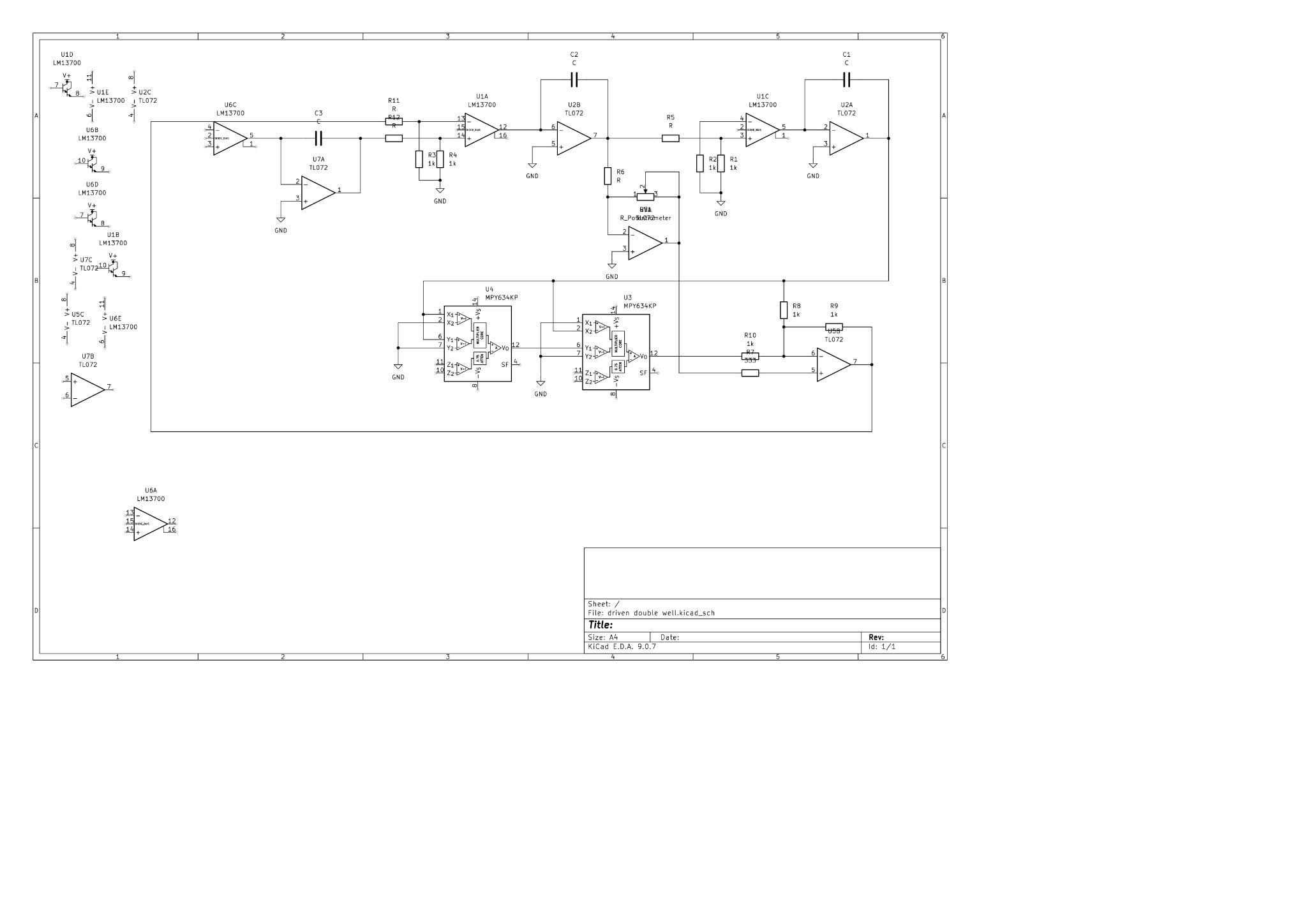
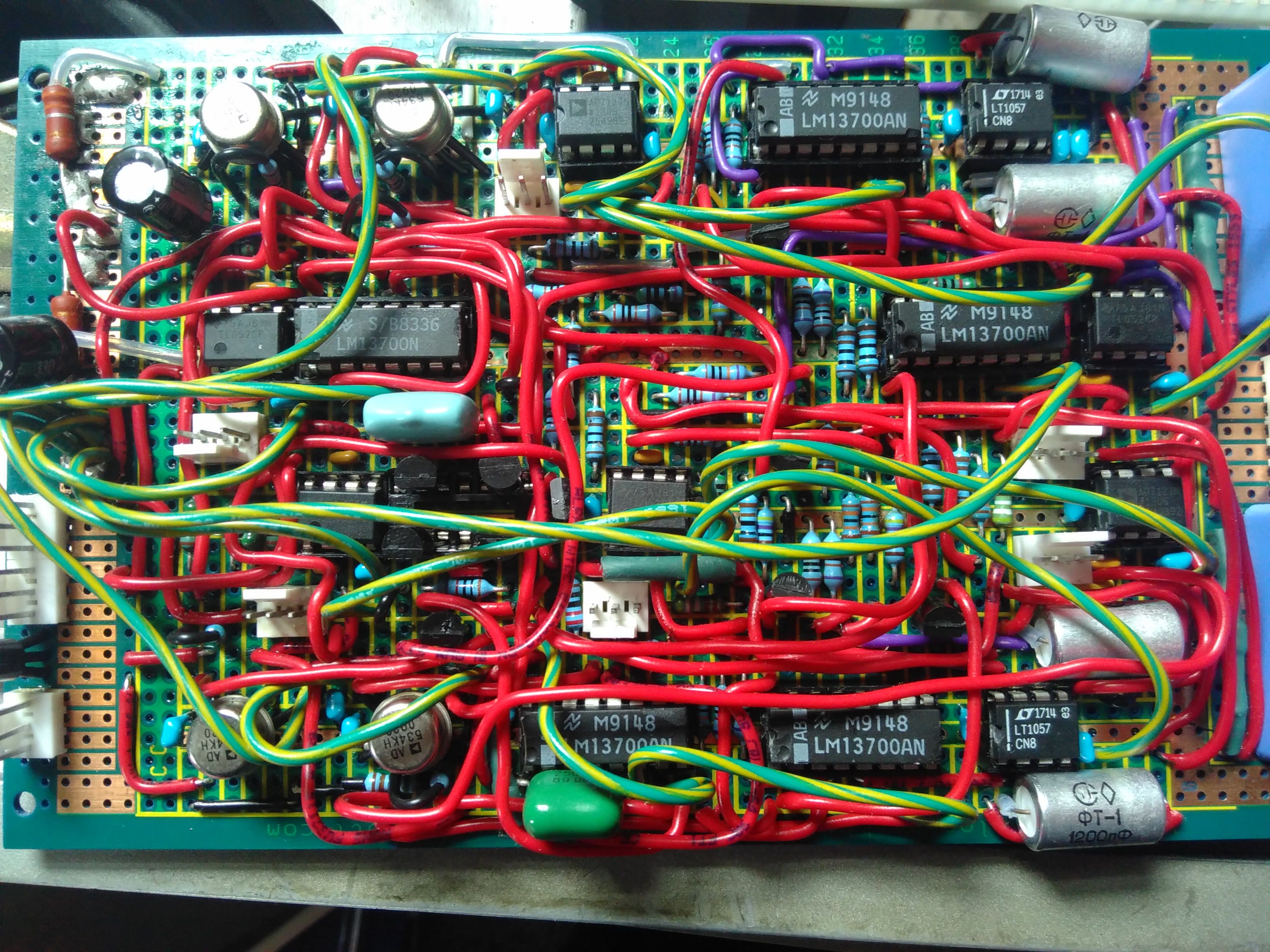
The prototype shown here was built on protoboard using LM13700 transconductance amplifiers, TL072 op amps, and analog multipliers to realize the coupled integrator, damping, and cubic restoring-force terms. The physical construction remains provisional, but the circuit operates as intended and demonstrates that a nonlinear double-well solver of this type can function directly as an audio-rate analog instrument.
This is significant less because of the specific equation involved than because of what it implies about the design space of analog instruments. The oscillator-filter-envelope model remains important and musically useful, but it need not define the full extent of analog synthesis. Circuits derived from continuous-time dynamical systems may also be approached as sound-generating structures in their own right. In such systems, the instrument is not only a signal path but an embodied dynamical process.
The driven double-well case is only one example. More generally, analog computational methods permit the hardware realization of a wide class of continuous-time systems. Some of these may prove unsuitable for musical use, while others may open new categories of controllable behavior not easily described in terms of traditional oscillator and filter language. The relevance of such circuits therefore lies not only in their novelty, but in their ability to suggest an expanded framework for what an analog synthesizer can be.
Seen in this way, the present circuit is best understood as a small experimental instance of a broader possibility: that audio-rate analog synthesis may be developed not only through established voice architectures, but also through the direct realization of nonlinear dynamical systems in hardware. The result is not a replacement for existing synthesizer forms, but evidence that the analog domain may still contain underexplored instrument topologies beyond the conventional subtractive model.